
Manufacturing Scope Versus Coordination: Trade-offs in a Festive Order
The most useful question to ask a fragrance manufacturer is not how much they can do, but how much of it they do inside their own operation. A wider scope removes handovers, and every removed handover removes a place where a festive deadline can slip. A narrower scope keeps each step with a specialist and gives you more room to change one of them. Neither choice is correct in general; the right answer depends on how fixed your date is and how likely your brief is to change. This piece sets out the trade-off honestly, including the parts that argue against the wider option.
Key takeaways
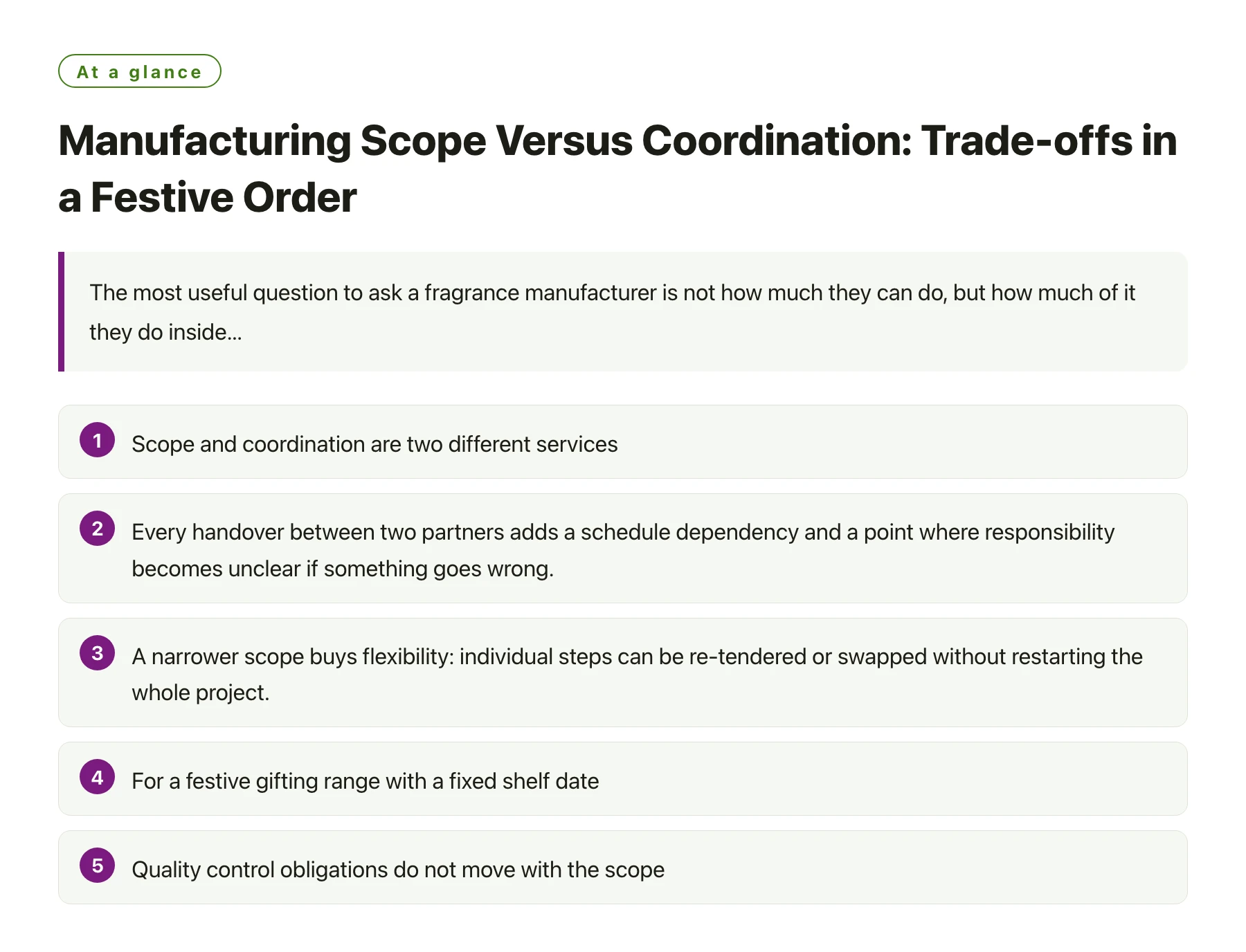
- Scope and coordination are two different services, and a supplier that offers both should be asked which parts of the job they actually run rather than coordinate.
- Every handover between two partners adds a schedule dependency and a point where responsibility becomes unclear if something goes wrong.
- A narrower scope buys flexibility: individual steps can be re-tendered or swapped without restarting the whole project.
- For a festive gifting range with a fixed shelf date, handover risk usually costs more than the flexibility it replaces, but only if the brief is genuinely frozen.
- Quality control obligations do not move with the scope, so the party who signs the release should be identified in writing regardless of how the work is split.
Buyers tend to evaluate manufacturers on capability: can you formulate, can you fill, can you print, can you pack. That is the wrong first question, because almost every credible factory answers yes to most of it. The question that changes outcomes is where the boundary of the operation actually sits, since that boundary decides how many other companies are quietly involved in your order.
The trade-off is real in both directions, which is why this article does not conclude with a recommendation. It sets out what sits inside a typical operation, what usually does not, and how to choose for a festive range specifically. Xuelei appears here in the same way any supplier would: as an example of an integrated scope, not as an argument that integration is always right.
What usually sits inside an operation and what usually does not
| Work stream | Often inside the factory | Often coordinated with a third party |
|---|---|---|
| Fragrance formulation | Drafting, adapting and blending the compound, plus retaining a reference sample | Specialist houses are sometimes used for directions outside the factory's palette |
| Safety and documentation | Collecting the material documentation and applying published standards | Independent safety assessors and external laboratories |
| Primary components | Bottles, pumps, caps and closures in standard shapes held in stock | Custom moulds, unusual glassware and specialist actuators |
| Filling and assembly | Filling, capping, labelling, inserting and closing the gift unit | Hand-finishing, hand-tying and craft assembly work |
| Secondary packaging | Standard cartons and simple printed boxes | Complex print finishes, rigid boxes and embossed inserts |
| Testing | In-house physical and organoleptic checks against the reference | Accredited laboratory testing for specific markets or claims |
| Logistics | Preparing export documents and palletising for collection | Freight booking, customs clearance and final-mile delivery |
Read the third column as the schedule risk column. Each entry there is another company with its own queue, its own holiday calendar and its own idea of what urgent means. When a festive order slips, the cause is disproportionately in that column rather than in the two on the left.
What coordination actually costs
Coordination is not free, but its cost is not mostly money. It is time spent reconciling versions, waiting for someone else's queue, and answering the question of who owns a defect when two parties touched it. The financial cost appears later, as expedited freight or as a reprint, and it is usually larger than the fee the coordinating party charged.
There is also a documentation cost. Materials used in fragrance are regulated through published standards and restrictions, and those obligations sit with the product rather than with whichever company performed the last step. [1] When the work is split, somebody has to assemble the full document set at the end, and that task has a schedule of its own.
The counter-argument deserves a fair hearing. A narrow scope lets you keep a specialist where specialism genuinely matters — an unusual bottle, a difficult print finish, an accredited test for a specific market — instead of accepting whatever the integrated option happens to offer. If your product depends on one of those things, the flexibility is worth more than the handover saving.
Where scope decisions become quality control decisions
Quality control is easiest when one party owns the reference sample and the release decision, because the comparison is direct. When assembly happens elsewhere, the reference has to travel, and every transfer is an opportunity for a stored sample to degrade or for a judgement to be made by someone who never saw the original.
The technical side of this is well established in the industry literature: organoleptic evaluation supported by instrumental checks, applied consistently across production lots, is what makes a release decision defensible. [2] A supplier that can describe its own release criteria in those terms is telling you that the process exists independently of the person running it.
It is also worth distinguishing the two commercial models at this point, because they place the reference sample in different places. A a manufacturer that supports OEM and ODM may hold the reference for an adapted direction while the brand holds the creative brief, whereas a purely made-to-specification arrangement puts almost everything on the brand side. The practical habits behind quality control in luxury fragrance production apply either way, and they are mostly about who compares what, when.
Where scope decisions become calendar decisions
A fixed festive date rewards the wider scope, provided the brief is frozen. If the brief is still moving, the wider scope can be a trap, because a late change to one component can disturb a schedule that no longer has any slack anywhere else.
The practical test is to ask, for each work stream, what happens if this item changes in four weeks. If the answer involves a partner's queue you do not control, you have found the part of the scope that deserves either extra margin or a narrower arrangement.
How to choose without overthinking it
Start by classifying the order. If the format is standard, the scent direction is settled and the date is fixed, the wider integrated scope is usually the lower-risk route, and the conversation with Xuelei perfume production can go straight to volumes, dates and documentation.
If the product depends on a distinctive component or finish, split the scope deliberately and keep the specialism where it adds something visible to the customer. The split should be designed rather than inherited; a supply chain that was assembled by accident is the one that surprises you in November.
If you are still deciding between suppliers, compare them on the boundary question rather than on a capabilities list. The framework for how to compare perfume factories is worth applying here, with particular attention to which party signs the release and which party holds the reference sample.
Whichever route you take, treat the quality function as a scope item of its own. Both integrated and split models can deliver consistent production, and both can fail; the difference is whether someone has been named as responsible for the comparison against the reference, and whether that responsibility is written down. [3]
One last consideration that rarely appears in capability tables: how the supplier behaves when a step goes wrong. Integration shortens the distance between the problem and the person who can fix it, but only if the organisation actually escalates internally rather than waiting for you to notice. Ask for an example of a deviation and how it was handled.
A useful exercise before signing: draw your order as a chain of boxes, one per work stream, and write the company name inside each box. Most buyers discover at least one box they had mentally assigned to the factory but which is actually filled by someone else. That drawing, not the capability presentation, is the real scope of your festive order.
Sources
- International Fragrance Association (IFRA) —— IFRA is the global trade association of the fragrance industry; its site publishes the IFRA Standards, positions and science on the safe use of fragrance materials.
- Cosmetics & Toiletries —— A technical magazine for cosmetic formulators, covering ingredients, formulation science and testing methods.
- HAPPI — Household & Personal Products Industry —— An industry magazine covering the household and personal care market, including fragrance, formulation and packaging.
Frequently asked questions
Is a factory with a wider scope always the better choice?
No. A wider scope usually reduces schedule risk because it removes handovers, but it also reduces your flexibility to change a single step. If your product depends on a specialist component or finish, a narrow scope with a deliberate split can be the better answer.
How do I tell whether a supplier really performs a step or just coordinates it?
Ask where the work happens, who employs the people doing it and who signs the release for that step. A supplier performing the work can describe its own equipment, staffing and inspection criteria; a coordinating supplier will refer to a partner. Neither answer is disqualifying, but you need to know which one you are buying.
Who is responsible for compliance when several companies are involved?
The obligation attaches to the product, so it does not disappear when the work is split. In practice the brand owner should name one party responsible for assembling the documentation set and confirm the format and language it will arrive in, rather than assuming coordination includes it.
Does splitting the scope make quality control harder?
It makes it more dependent on documents. When one party owns the reference sample and the release decision, comparison is direct. When the product moves between parties, the reference has to travel and the release criteria have to be written clearly enough for someone else to apply them.
What should be frozen before a festive order is committed?
The formula, the primary component, the pack configuration and the print artwork should all be frozen together, and the delivery date should be counted backwards from the shelf date including any external testing. Leaving one of those open is the most common reason a festive order becomes a January delivery.
Take the next step in your practice.
Browse ritual supplies, spell kits and divination tools curated by our in-house coven — backed by a 90-day Right Craft guarantee.
Shop the Collection Book a Consultation